The headline immediately drew your attention. “New AI Achieves Human-Level Consciousness.” Your colleague shared it in the group chat. By afternoon, three people had referenced it in meetings. By evening, a quick search revealed the original paper said nothing of the kind — it described improved pattern recognition in a narrow domain. But the narrative had already detached from reality and was circulating faster than any correction could travel.
This is how misinformation about AI trends operates. Not through deliberate conspiracy, but through a chain of small distortions. A researcher makes a modest claim. A press release amplifies it. A headline exaggerates the press release. Social media strips nuance entirely. By the time you encounter it, the original meaning is unrecognizable — and the emotional impact is fully intact.
Resolving this problem isn’t about becoming a fact-checking robot. It’s about building habits that catch distortions early, before they shape your decisions and conversations. The goal isn’t perfect accuracy — it’s sufficient resistance to prevent obvious falsehoods from colonizing your thinking.
The Anatomy of a Distortion
Understanding how misinformation spreads helps you spot it in progress. Most AI trend distortions follow a predictable path through several stages, each adding a layer of exaggeration or simplification.
Stage one is the source material — usually a research paper, a product announcement, or a technical blog post. This is often cautious, qualified, and specific. Researchers are trained to understate claims to survive peer review.
Stage two is the institutional translation — a university press office or company marketing team converting technical findings into language that attracts attention. This is where “modest improvement in specific task” becomes “breakthrough in artificial intelligence.” The core finding is still present, but the framing shifts toward excitement.
Stage three is media coverage, where competition for clicks rewards dramatic headlines over accurate summaries. The incentive is to make readers feel something — surprise, fear, hope — because emotional engagement drives sharing.
Stage four is social media, where the headline becomes the entire story for most readers. Nuance evaporates. Context disappears. The claim floats free from any evidence and attaches to whatever narrative the sharer already believes about AI.
By the time you see it, you’re looking at stage four material that references stage one authority. The credibility of the original research lends weight to claims that bear no resemblance to what the researchers actually said.
Detection Signals That Actually Work
You don’t need technical expertise to catch most AI misinformation. You need attention to specific signals that indicate distortion is happening. These signals are visible in the language itself, regardless of the technical subject matter.
Absolute language. “AI will,” “AI cannot,” “This changes everything.” Reality is almost always more conditional. Genuine technical developments have constraints, limitations, and contexts. Claims that ignore these are usually simplified past the point of accuracy.
Anthropomorphism. AI “understands,” “feels,” “wants,” “decides.” These are human concepts applied to statistical pattern matching. Sometimes they’re harmless shorthand, but they often obscure what’s actually happening and inflate the perceived capabilities of the system.
Missing numbers. “Dramatic improvement” without specifying improvement over what baseline, measured how, in what conditions. “Faster than ever” without saying how fast, or compared to which previous system. Specificity is the friend of accuracy; vagueness is its enemy.
Single-source stories. A claim that only appears in one outlet, with no corroboration from independent researchers or competing publications. Real developments attract multiple perspectives. Hype often travels alone.
Timeline compression. “Soon,” “in the near future,” “just around the corner” without dates. This creates urgency without accountability. If the prediction fails, the timeline was vague enough that no one can call it wrong.
The Quick Skepticism Check
Before sharing or acting on any AI trend claim, run through these:
• Can I state the claim in my own words, without the original language?
• What would prove this claim wrong? Is that even possible?
• Who benefits if I believe this? Who loses?
• If I wait a week, will this still matter, or will it be forgotten?
If you can’t answer these clearly, the claim hasn’t earned your belief yet. Pause before spreading it.
Tracing Back to Source
The most reliable fix for misinformation is also the simplest: find what the claim is actually based on. This takes effort, which is why most people don’t do it. But the effort is usually smaller than the anxiety of acting on false information.
Start with the headline or social post. Look for any link to a source. If there isn’t one, that’s already a red flag — credible claims usually reference their origin. If there is a link, follow it. Don’t stop at the press release; keep going to the original paper, announcement, or technical documentation.
When you reach the source, compare the original language to what you’ve been reading. Is the headline’s “breakthrough” present in the paper, or is it the press office’s addition? Does the research actually claim what the article says it claims? Often the gap is obvious once you see both versions side by side.
This tracing habit becomes faster with practice. You learn which publications reliably distort and which tend to summarize accurately. You recognize the difference between a preprint on arXiv and a peer-reviewed paper in a journal. You know which company blogs are substantive and which are pure marketing.
Correcting Without Alienating
When you spot misinformation, the instinct is to correct it immediately and forcefully. This usually backfires. People don’t like feeling foolish, and aggressive correction triggers defensiveness rather than reflection. The misinformation survives by moving to someone who won’t challenge it.
Effective correction requires a different approach. Ask questions rather than make statements. “I saw that headline too — did you read the original paper? I couldn’t find where they claimed consciousness.” This invites conversation rather than confrontation. It gives the other person room to discover the distortion themselves, which is more persuasive than being told they fell for it.
Share alternative sources rather than just contradicting. “Here’s the actual research if you’re curious — the findings are interesting but more limited than the article suggested.” This positions you as helpful, not adversarial. It also gives the other person a path to correct their own understanding without public admission of error.
Know when not to correct. In large groups, in high-emotion moments, or when the misinformation is tangential to the real conversation, correction often derails more than it helps. Pick your battles. The goal is reducing overall misinformation, not winning every exchange.
The Gentle Correction Script
When someone shares something you know is distorted:
Acknowledge the interest: “That headline got my attention too.”
Introduce complexity: “When I looked into it, the actual research was more specific than the article suggested.”
Offer the source: “Here’s the original if you want to see what they actually measured.”
Shift forward: “The real finding is still interesting, just different from what the headline implied.”
This pattern respects the other person’s intelligence, gives them an escape route, and plants the seed of future skepticism without requiring immediate agreement.
Building Immunity in Your Network
Individual resistance to misinformation is necessary but insufficient. Misinformation spreads socially, and the most effective defense is social too. You want the people around you to also be skeptical, also tracing sources, also pausing before sharing.
Model the behavior you want to see. When you share AI news, include the source and a brief note about what the study actually measured. When you discuss trends, mention limitations and uncertainties naturally, not as afterthoughts. When you’re wrong — and you will be — acknowledge it openly. This creates an environment where correction is normal rather than confrontational.
Introduce others to your skepticism habits gradually. Share a particularly egregious headline and walk through how you traced it back to the mundane reality. Make it interesting, not preachy. The goal is showing that the detective work is fun and rewarding, not that others are gullible.
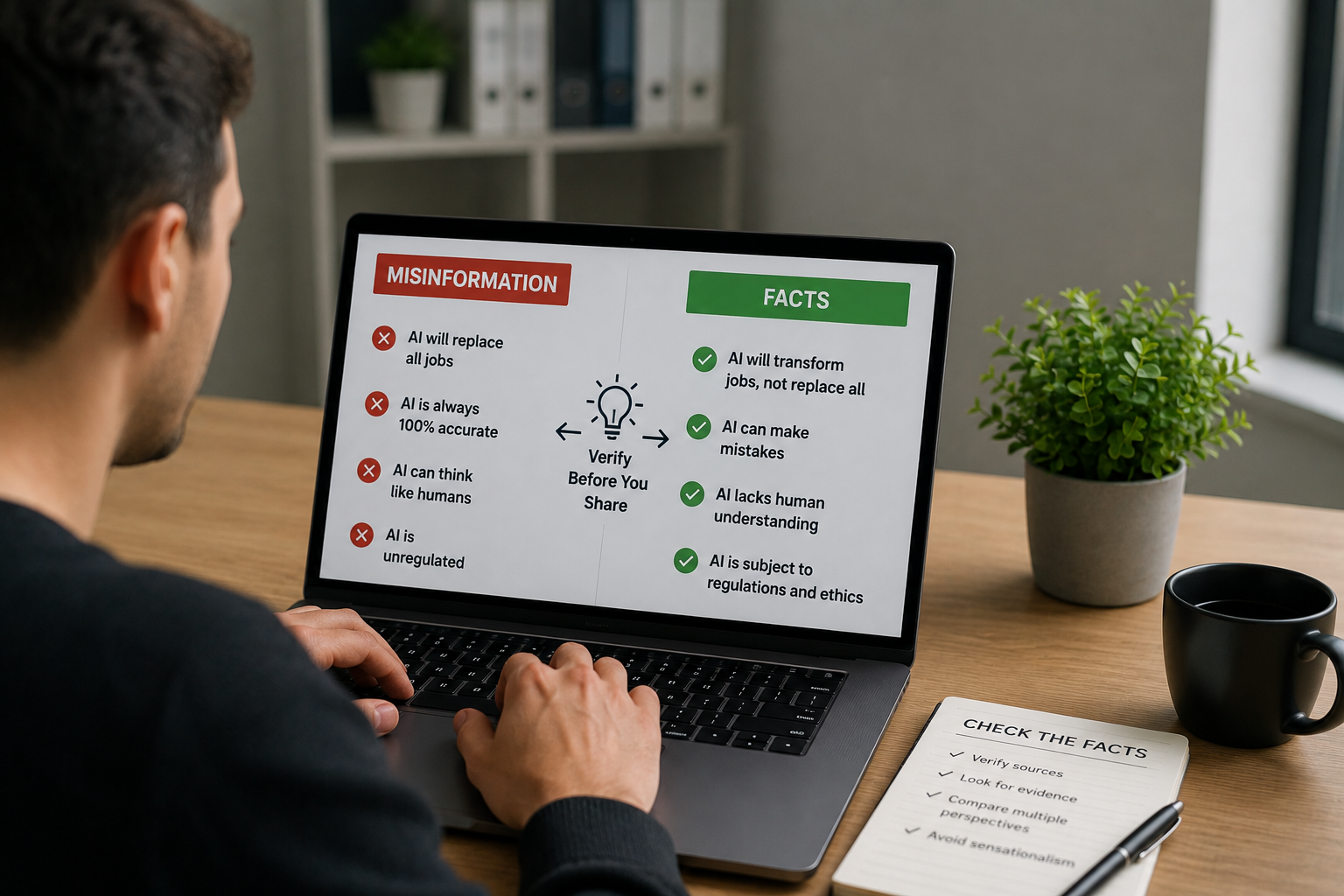
| Misinformation Pattern | Why It Spreads | Your Response |
|---|---|---|
| “AI will replace [entire profession]” | Fear drives engagement; confirmation bias for those anxious about jobs | Ask which specific tasks, on what timeline, with what evidence. Replacement claims are rarely specific enough to evaluate. |
| “This AI achieved human-level [ability]” | Impressiveness sells; anthropomorphism feels natural | Check if the benchmark was narrow and artificial. “Human-level” in chess is not human-level in general reasoning. |
| “Scientists are divided about AI danger” | Controversy is more interesting than consensus | Look for what specifically they’re divided about. Vague “danger” claims often mask agreement on specifics with disagreement on framing. |
| “No one saw this coming” | Surprise creates urgency; implies you must act now | Check if experts in the field actually predicted this. “No one saw it coming” is often code for “I wasn’t paying attention.” |
When You Are the Source
The hardest misinformation to catch is your own. You read something, remember the gist, and later repeat it with confidence. Over time, the gist drifts. The qualification you forgot becomes the crucial detail that changes the meaning. You become an unwitting vector for distortion.
The fix is source discipline. When you learn something surprising about AI, note where you learned it. Before repeating it, check your note. If you can’t find the source, don’t repeat the claim. This feels excessive until you catch yourself about to share something you half-remembered from a headline you can’t locate.
Also practice saying “I don’t know” and “I need to check that.” These phrases feel like admissions of weakness but function as strengths. They protect you from becoming a conduit for false information and signal to others that accuracy matters more than appearing informed.

Cathy started out teaching herself to code through documentation and broken tutorials, which taught her more about learning than any classroom did. Now she focuses on helping others navigate the same path — figuring out why things break, how to fix them, and what trends actually matter versus what’s just noise. She has a background in cognitive science and contributes to open-source education projects.