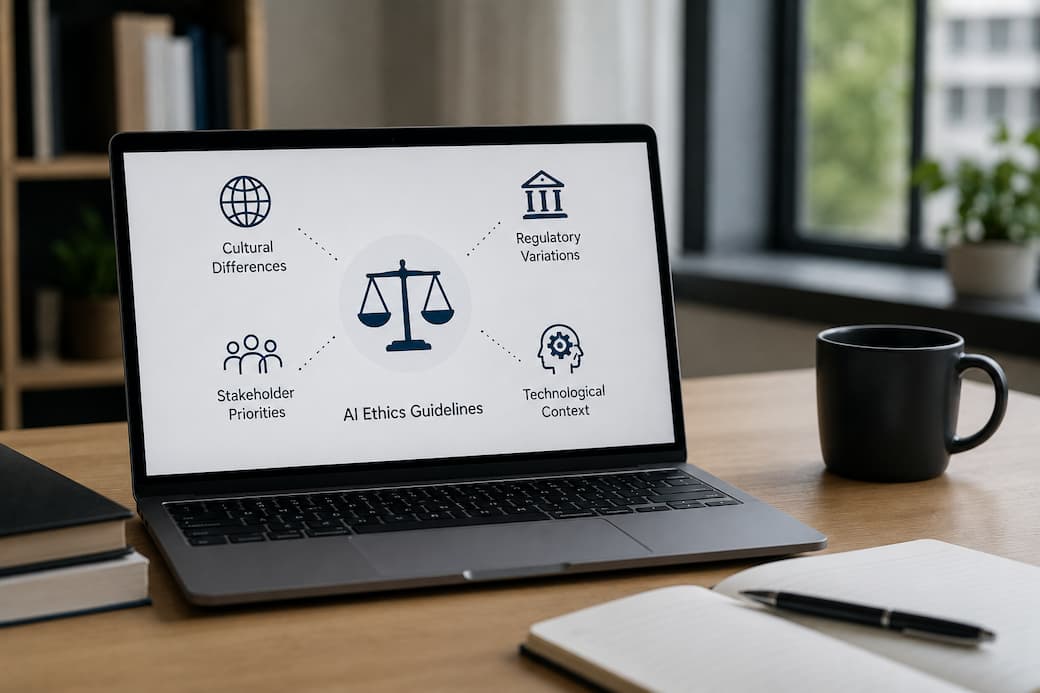
You read one set of guidelines that says AI should be transparent and explainable. Another set says transparency matters less than accuracy. A third says both matter, but only if they don’t slow down innovation. You look for a single answer and find a landscape of partial agreements, national differences, and industry-specific exceptions. The confusion isn’t in your reading — it’s in the reality.
AI ethics guidelines vary because they emerge from different contexts, different fears, and different priorities. Understanding why they differ is the first step to navigating them without getting lost in contradictions. The goal isn’t to find the one true guideline. It’s to know which guidelines apply to your situation and how to work with the tensions between them.
The Geography of Ethics
Where a guideline comes from tells you a lot about what it cares about. The European Union’s approach centers on fundamental rights and risk prevention. The United States emphasizes innovation and sector-specific regulation. China’s framework prioritizes social stability and state oversight. These aren’t random differences — they reflect deep values about the relationship between technology, citizens, and government.
The EU’s AI Act, for example, categorizes AI systems by risk level and bans certain uses entirely — social scoring, manipulation of vulnerable people, real-time biometric identification in public spaces. The underlying assumption is that some applications are too dangerous to regulate; they should not exist. This reflects a precautionary principle: prove safety before deployment.
The US approach, by contrast, tends to regulate by sector rather than by technology. Healthcare AI falls under FDA oversight. Financial AI falls under existing financial regulations. The underlying assumption is that AI is a tool like any other, and existing regulatory frameworks can adapt. This reflects a trust in market mechanisms and post-hoc correction: deploy, observe, regulate problems as they emerge.
Neither approach is objectively right. They optimize for different things. The EU optimizes for citizen protection at the cost of slower innovation. The US optimizes for speed at the cost of higher risk of harm. Knowing which system you’re operating in tells you which rules bind you and which expectations shape your stakeholders.
| Region/Approach | Core Priority | Typical Regulatory Style | What This Means for Practitioners |
|---|---|---|---|
| European Union | Fundamental rights, risk prevention | Comprehensive, preemptive, risk-based categories | Document risk assessments before deployment; expect compliance audits |
| United States | Innovation, sector-specific balance | Fragmented, reactive, industry-by-industry | Know your industry’s specific regulators; watch for emerging state laws |
| United Kingdom | Pro-innovation with sector flexibility | Principles-based, regulator-led adaptation | Follow regulator guidance for your specific sector; principles over prescriptive rules |
| China | Social stability, algorithmic accountability | State-directed, content-focused, registration requirements | Register algorithms with authorities; expect content moderation integration |
The Industry Layer
Even within the same country, different industries operate under different ethical expectations. Healthcare AI faces strict requirements for accuracy, explainability, and human oversight because errors cause direct physical harm. Financial AI faces requirements for fairness, transparency, and auditability because errors cause economic harm and erode trust. Creative industries face debates about authorship, compensation, and the value of human expression.
These industry differences mean that a general AI ethics guideline is necessarily incomplete. It can state broad principles — fairness, transparency, accountability — but the implementation details depend on what you’re actually building and who it affects. A fair loan algorithm and a fair hiring algorithm face different constraints because the harms of unfairness manifest differently.
This is why practitioners often feel that guidelines are either too vague to be useful or too specific to apply broadly. Both complaints are true. The vagueness is necessary for cross-industry applicability. The specificity is necessary for actual implementation. The skill is knowing when to apply which.
The Tensions You Can’t Resolve
Some ethical tensions in AI aren’t solvable — they’re trade-offs you have to navigate. Transparency versus accuracy is a classic example. Making an AI system fully explainable often means using simpler models that are less accurate. Using more accurate complex models often means accepting a “black box” that can’t fully explain its decisions. Both choices have ethical implications.
Privacy versus utility is another. AI systems generally perform better with more data. But more data collection raises privacy concerns. The optimal balance depends on context: medical research justifies different trade-offs than social media advertising.
Speed versus safety is a third. Rushing AI to market captures competitive advantage but increases the risk of undiscovered harms. Moving slowly allows more testing but may mean the technology never reaches people who could benefit.
Navigating Unresolvable Tensions
When you face a genuine ethical trade-off, document your reasoning:
• What values are in tension? Name them specifically. “Transparency” and “accuracy” are more useful than “good things.”
• Who benefits from each choice? And who bears the risk? Be honest about power dynamics.
• What would change your mind? Define the evidence or circumstance that would shift your position.
• Who did you consult? Ethical decisions made in isolation are more likely to reflect unexamined bias.
This documentation doesn’t make the tension disappear. But it makes your reasoning inspectable, which is often the most ethics can practically demand.
Building Your Personal Navigation System
Given this complexity, how do you actually work? Not by memorizing every guideline — that’s impossible. By building a lightweight system that helps you find the right guidance when you need it.
Know your primary jurisdiction. Which country’s regulations actually bind you? If you operate globally, which ones bind your specific product or service? Start there. Add others only as they become relevant.
Know your industry’s key documents. Healthcare? The FDA’s guidance on AI/ML-based medical devices. Finance? The EU’s guidelines on AI in insurance and the US fair lending standards. Each industry has a small set of authoritative documents that matter more than the rest.
Follow one generalist source. A newsletter, blog, or organization that tracks cross-cutting AI ethics developments without drowning you in detail. The goal is awareness of emerging issues, not comprehensive coverage.
Build a decision log. When you make an ethically significant choice in your AI work, write down what you decided, why, and what guidelines you consulted. Over time, this becomes your personal playbook — tailored to your specific context and reusable when similar situations arise.
When Guidelines Conflict
Conflicts are inevitable. Your EU customers expect GDPR-compliant data practices. Your US investors want rapid iteration that those practices might slow. Your internal team has its own ethical intuitions that don’t map neatly to either framework.
The first step is acknowledging the conflict rather than pretending one guideline simply wins. The second is understanding the enforcement reality. Which guidelines have actual legal consequences? Which are industry norms that affect reputation? Which are aspirational statements with no teeth?
Then prioritize. Legal requirements are non-negotiable. Reputational risks are business decisions. Aspirational goals are directional. This hierarchy doesn’t resolve every tension, but it gives you a starting point for negotiation rather than paralysis.
The Conflict Resolution Hierarchy
1. Legal requirements: Violating these has direct consequences. Compliance is mandatory, not optional.
2. Contractual obligations: Customer or partner agreements that specify ethical standards. These bind you even if not legally required elsewhere.
3. Industry norms: Standards that affect your ability to operate credibly. Violating these risks reputation and relationships.
4. Organizational values: Your company’s stated principles. These matter for internal cohesion and external trust.
5. Personal ethics: Your own moral framework. This is valid but operates in tension with the other layers. Know when you’re making a personal stand versus a professional decision.
Related Articles
- Common Reasons People Misunderstand Future AI Trends
- Simple Guide to Understanding AI Trends for Beginners
- Easy Ways to Stay Updated on Future Technology Changes
- How to Fix Misinformation About Emerging AI Trends
- Common Reasons Future Tech Feels Unreachable and Fixes
- Simple Guide to Choosing the Right AI Tool for Work
- Easy Ways to Learn New AI Software Without Stress
- Why Workers Worry About AI Jobs and How to Adapt
Sources and References
European Union: Artificial Intelligence Act (2024)
Comprehensive risk-based regulatory framework for AI systems operating in the EU market, establishing categories of prohibited, high-risk, and limited-risk AI applications with corresponding compliance obligations.
IEEE Standards Association: Ethically Aligned Design
Global technical standards for embedding ethical considerations into autonomous and intelligent systems, emphasizing transparency, accountability, and reduction of bias across cultural contexts.
National Institute of Standards and Technology: AI Risk Management Framework
US voluntary guidance for managing risks in AI systems, organized around governance, mapping, measuring, and managing risks with sector-agnostic applicability.
Jobin, Anna, et al. “The Global Landscape of AI Ethics Guidelines.”
Comprehensive analysis published in Nature Machine Intelligence mapping 84 AI ethics guidelines across countries and organizations, identifying convergences and divergences in underlying principles and implementation approaches.

Cathy started out teaching herself to code through documentation and broken tutorials, which taught her more about learning than any classroom did. Now she focuses on helping others navigate the same path — figuring out why things break, how to fix them, and what trends actually matter versus what’s just noise. She has a background in cognitive science and contributes to open-source education projects.