
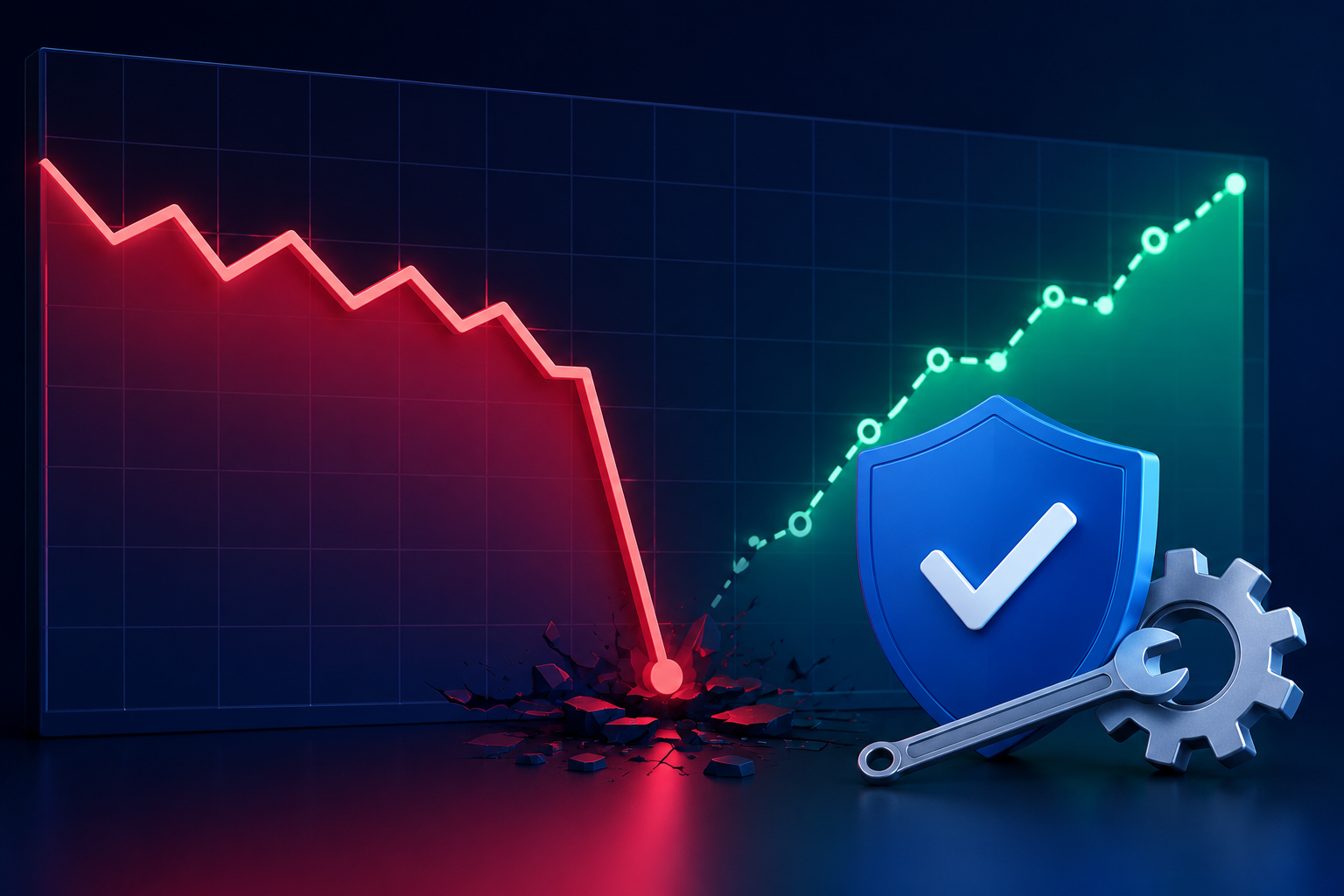
Building a cost-effective machine learning model is difficult. Keeping it performing well in real life is another challenge. Once accurate models can degrade without warning, they often do so gradually enough to go undetected until damage is done. Any team implementing models at scale must understand why and how to fix this issue.
Understanding Model Degradation
A machine learning model’s ability to make accurate predictions gradually or suddenly degrades after deployment. Model deterioration is more subtle than software faults, which produce abrupt failures. The model runs. Predictions persist. Accuracy, precision, and memory begin to decline over weeks or overnight. Every machine learning model assumes that its training data will match its output data, which is why deterioration occurs. When that assumption fails, performance follows.
Common Accuracy Decline Causes
Several variables can lower model accuracy. Missing data, damaged records, and upstream pipeline problems might provide noise the model cannot handle. Another typical cause is feature engineering modifications, which alter input data processing or encoding without updating the model. External issues might arise when a third-party data source changes its structure or a new product feature modifies log user behavior. Any of these can easily destabilize a model.
Impact of Data Drift
Over time, the statistical qualities of input features change, which causes data drift. A fraud detection algorithm trained with 2022 transaction data will have learned economic and behavioral tendencies. As consumer buying patterns changed substantially during and after the COVID-19 epidemic, the model’s production input distribution will differ from its training. The model’s learned weights mismatch the new reality, reducing accuracy. Data drift is especially sneaky because the model hasn’t changed. No issues with the training process, code, or infrastructure. The issue is just with training and production data.
Concept Drift: Changing Relationships
Concept drift differs from data drift. Concept drift shifts the input-target variable connection, not the inputs. A model that predicts customer attrition may have learned that logon frequency drops substantially, indicating cancelation. If the firm launches a new mobile app that affects how people use the product, the same login behavior may signify something else. The inputs seem the same but signify differently. A product change, regulatory move, or world event might cause concept drift, or it can happen slowly, so no week indicates an alarming decline. While both are harmful, steady drift is harder to identify and produces greater cumulative damage.
Strategy to Reduce Data and Concept Drift
Most successful mitigation measures are source-based. For data drift, teams should keep complete statistical profiles of training data and compare them to production data. Evidently, AI, WhyLabs, and Arize AI are designed to automate feature distribution comparison over time. The system indicates features with distributions that exceed a threshold for study. A distinct viewpoint is needed for notion drift. Teams must track inputs and results, not just input distributions. Logging model predictions and ground truth labels and rolling out performance measures is common. Proxy metrics and human labeling pipelines can bridge the gap when ground truth is delayed, as in real-world applications.
Alerting and Monitoring Systems
No mitigation approach works without strong monitoring. Like software systems, production ML systems need performance dashboards, automatic alarms, and clear escalation pathways when anything goes wrong. A well-designed monitoring setup tracks data quality metrics (null rates, schema compliance, value ranges), feature distribution statistics (mean, variance, skewness), model output distributions (prediction confidence, class balance), and downstream business metrics. Any signal that deviates from baseline triggers a warning before the situation worsens. Teams typically neglect this layer, treating monitoring as an afterthought after the model ships. That decision often results in poor suggestions, wrong classifications, or unsuccessful automations that damage user confidence.
Retrain and Update Models
Retraining is the straightforward remedy to accuracy reduction, but it takes attention. Retraining on the latest data without considering its sparseness, seasonal bias, or abnormal period may result in a weaker model. An organized retraining policy, triggered monthly or quarterly or by monitoring performance benchmarks, is superior. Shadow deployment—running a newly trained model alongside the production model without serving real traffic—validates changes before a complete rollout. A/B testing, canary deployments, and champion-challenger frameworks verify that retrained models increase performance before replacing the incumbent.
Practical Examples and Case Studies
The repercussions of disregarding model drift are well known. Retailers’ demand forecasting algorithms crashed early in the COVID-19 epidemic. Since these models were built on years of constant consumer behavior, the rapid shift to pantry stocking and the elimination of in-store traffic were completely unexpected. McKinsey reported in 2020 that several merchants had to switch to manual forecasting when their AI systems failed overnight.
Similar issues plagued credit scoring methods. Lockdown-era revenue interruptions changed repayment habits beyond past training data, prompting lenders to manually overlay automated choices. These examples demonstrate a key lesson: a machine learning model’s usefulness lies in its capacity to adapt to changing conditions.
Top Tips for Maintaining Accuracy
Keeping the deployed model alive, not finished, maintains model correctness. Teams that maintain accuracy over time version their training data alongside their model artifacts, define and document baseline performance metrics at deployment, clearly assign monitoring responsibilities, and schedule regular model reviews regardless of alerts. Adding drift detection to the MLOps pipeline rather than as a distinct project may be the most important structural choice. Automatic monitoring and well-governed retraining make accuracy declines manageable episodes, not emergencies.
Maintaining Model Reliability
Model accuracy decreases indicate that deployed models need continuing maintenance, not that machine learning doesn’t function. The causes are widely understood: data distributional shifts, shifting input-outcome linkages, and monitoring gaps that allow issues to fester unnoticed. Solutions are tangible too. Teams that prioritize observability, rigorous retraining, and production ML as an operational discipline will spend less time firefighting and more time extracting value from their models.
FAQs
1. Why does deployment suddenly reduce my model’s accuracy?
Data drift, idea drift, upstream data pipeline failures, and feature engineering modifications are the most typical causes of sudden accuracy decreases in deployed models. Real-time input data and model output monitoring is the best technique to detect these decreases.
2. Difference between data drift and idea drift?
Data drift occurs when input feature statistical qualities change, making the model’s data seem different from what it was trained on. Concept drift occurs when the connection between inputs and the goal variable changes, even while the inputs are comparable. Both reduce model accuracy but need distinct detecting methods.
3. Machine learning models should be retrained how often?
Rate of production environment change determines retraining frequency. Fast-moving models like fraud detection, demand forecasting, and content suggestion may need monthly or weekly retraining. Domains with less instability may simply need quarterly updates. Performance-threshold-based triggers with set schedules are most dependable.
4. What tools can I use to track model drift?
Some MLOps technologies are developed for drift detection and model monitoring. Evidently, WhyLabs, Arize, and Fiddler AI are popular platforms. Many cloud services, such as AWS SageMaker Model Monitor and Google Vertex AI Model Monitoring, enable native drift detection.
5. Can retraining a model hurt performance?
Yes. Retraining on scarce, seasonally skewed, or aberrant recent data can worsen model performance. To avoid this risk, utilize shadow deployment or A/B testing to check a retrained model against the production incumbent before replacing it, and make sure the retraining dataset matches the deployment distribution.

Cathy started out teaching herself to code through documentation and broken tutorials, which taught her more about learning than any classroom did. Now she focuses on helping others navigate the same path — figuring out why things break, how to fix them, and what trends actually matter versus what’s just noise. She has a background in cognitive science and contributes to open-source education projects.