
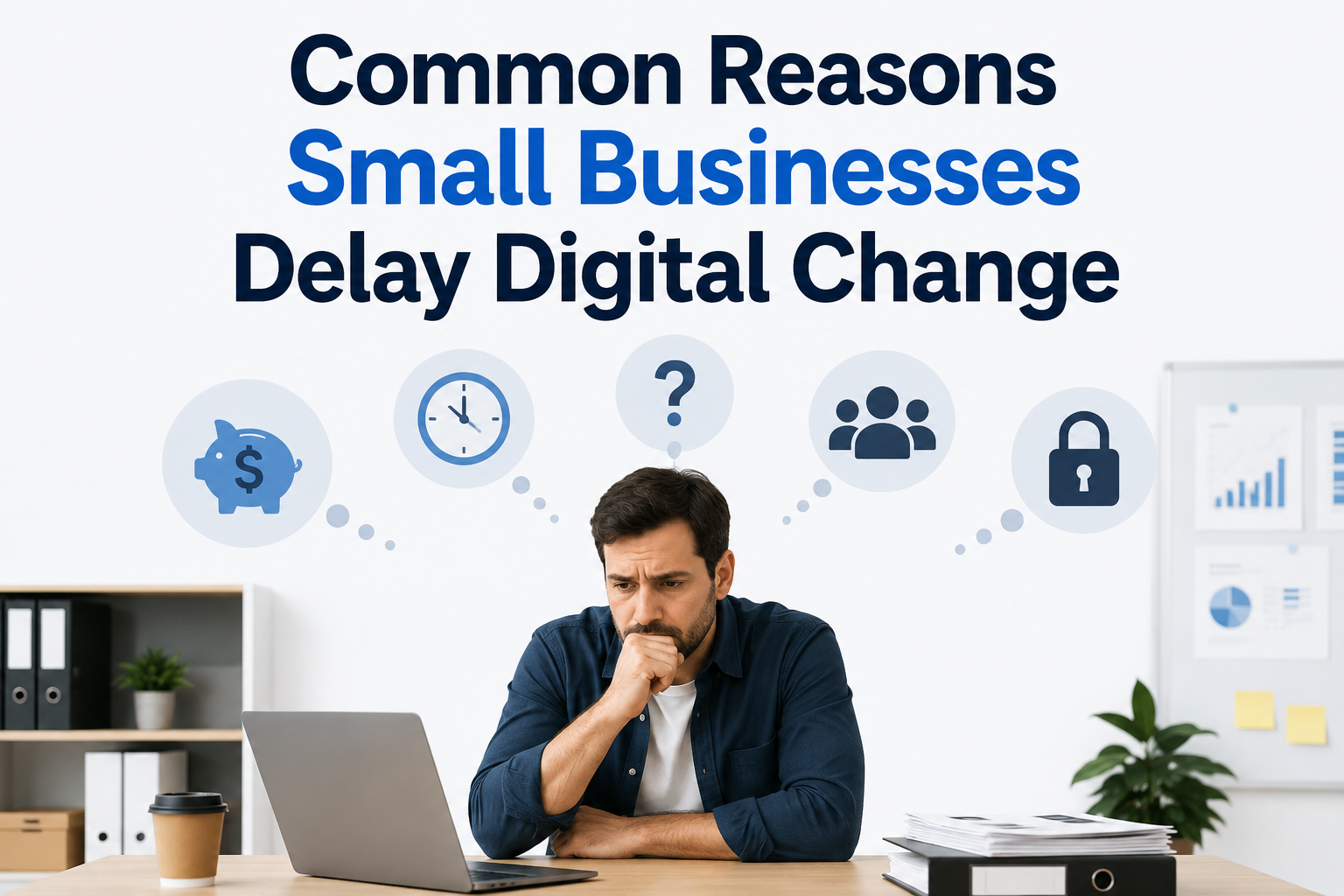
In today’s rapidly changing world, businesses cannot function without digital tools. Technology helps companies save time, reduce costs, and serve customers better. From online payments to cloud storage, from digital marketing to automation: technology is everywhere. Yet, many small businesses, even those aware of the operational efficiency benefits of digital transformation, choose to postpone their transition.
This delay is not necessarily due to a lack of technological knowledge among entrepreneurs, but often stems from practical problems, limited resources, and the fear of making the wrong choice. Small businesses have limited financial resources and small teams, making everything seem risky and far-reaching. The first step to addressing this problem is understanding why small businesses postpone digital transformation. Once these barriers are removed, companies can more easily take steps towards modernization without overburdening the organization.
Costs and Budget Constraints
Costs are one of the main reasons why small businesses postpone digital transformation. Many entrepreneurs believe that digital tools, software subscriptions, and automation systems are expensive and only affordable for large enterprises. For small businesses, every expenditure is crucial. Even if digital technology offers long-term benefits, costs are inevitable. The initial investment can feel risky. Entrepreneurs sometimes have to prioritize immediate needs such as rent, wages, and inventory over investments in technology.
However, this attitude can have negative consequences over time. Companies that do not use digital technologies may spend more time and money on manual processes. Manual invoicing, for example, seems cheaper than electronic invoicing at first glance, but often leads to errors, delays, and lower productivity. The real challenge lies not only in the costs but also in identifying the value. Digital transformation does not necessarily require expensive systems. There are many affordable tools available, specifically designed for small businesses, that can grow with the company.
Concerns About Technical Difficulty and Complexity
Another common reason for delaying digital transformation is the fear that technology is too complex. Many small business owners feel that they do not possess sufficient technical knowledge to use current products effectively. This concern is not unfounded. Learning a new system can be a daunting task when employees are already busy with sales, customer service, and operational duties. Tools that appear complex are often overlooked or postponed.
Most digital products today prioritize simplicity and ease of use as core values. Now, all accounting, customer management, and online marketing platforms focus on creating user-friendly interfaces. The problem lies not in the technology itself, but in the perception of its complexity. Companies that learn these tools often find them simpler than expected. Training and a step-by-step approach also help to alleviate this fear. The more small businesses realize how easy digital technologies are to use, the less resistance they will offer.
Lack of Insight into Existing Digital Solutions
For many small businesses, reluctance regarding digital transformation stems from a lack of in-depth insight into existing tools. Furthermore, small businesses often rely on traditional methods such as word-of-mouth. As a result, they may not realize that cost-effective solutions already exist for their challenges. For example, some companies still use handwritten spreadsheets for inventory management, unaware that simple cloud technology can automate the entire process.
This ignorance leads to a gap between practice and feasibility. The solution lies in education and awareness. Entrepreneurs who follow industry trends, attend seminars, or subscribe to digital business materials can often identify technologies that can significantly improve their business operations. As awareness increases, hesitation naturally diminishes.
Fear of Disruption to Existing Workflows
Small businesses rely on routine processes that have worked well for years. Although these systems are not perfect, they are easy to recognize and robust. Introducing digital changes means disrupting existing patterns, which can be unsettling. Many entrepreneurs worry that new technologies will disrupt business operations or confuse employees. This fear of disruption often hinders the adoption of new technologies.
A store that still handles manual invoicing, for example, fears that switching to a digital POS system will cause delays in customer interaction. However, we often overlook that short-term disruption usually leads to long-term progress. Although there may be a learning curve, digital technologies will ultimately make work processes faster and more efficient. The key is to proceed gradually. Small businesses can introduce digital technologies step-by-step, rather than all at once, to minimize disruption.
Lack of Time and High Workload
Small business owners often hold multiple roles. They are responsible for operations, customer service, marketing, and finance, to name just a few. As a result, they rarely have time to focus on digital transformation. They may well understand the benefits of digital transformation, but are too busy with their daily tasks to pay attention to it.
**Time is one of the most practical obstacles to digital transformation.** Entrepreneurs often think they do not have time to learn new processes, research products, and train employees. The reality is not a lack of interest, but rather limited resources. To overcome this obstacle, companies can make small, time-saving adjustments, such as gradually automating processes or implementing basic technologies that do not require installation. These seemingly small changes, which accumulate over time, will eventually lead to a significant transformation.
Fear of Investment Errors
Another factor hindering digital transformation is the fear of choosing the wrong tools or platforms. With an abundance of available options, small business owners often feel overwhelmed and uncertain about which solutions are truly suitable. This uncertainty can lead to indecisiveness, causing companies to delay choices to avoid errors.
For example, a company might spend weeks researching various accounting software but ultimately implement none of it. This fear stems from the fact that investments in the digital age cannot always be easily recouped. However, sometimes delaying a choice costs much more than making a minor error. The simplest way to get started is to start small, use scalable tools, and solve one problem at a time, rather than wanting to be perfect from the beginning.
Lack of Digital Skills and Training
A lack of relevant skills among employees and entrepreneurs is one of the reasons why many small businesses struggle with digital transformation. Even the simplest tools can be overwhelming if people do not know how to use them. This skills gap poses a significant challenge, especially for companies that have relied on traditional business models for a long time.
However, digital skills are no longer the exclusive domain of techies. Most existing technologies target non-technical users and provide tutorials, manuals, and support. The key is the willingness to learn. Even simple training can significantly boost confidence and remove hesitation. When small businesses are willing to invest time in learning, digital transformation becomes much easier and more natural.
Short-Term Thinking Over Long-Term Benefits
Many small businesses focus too much on short-term survival. Daily sales, costs, and customer needs often take precedence over long-term planning. Therefore, digital transformation is often viewed as a project for the future rather than an immediate necessity.
But this shortsighted mindset can hinder progress. Developing digital tools is aimed at improving productivity, reaching more customers, and increasing long-term profitability. For example, an investment in a medium-sized online booking system might not yield an immediate financial return, but in the long run, it can increase consumer convenience and boost revenue. Companies that postpone digital transformation often overlook these long-term benefits.
Uncertainty Regarding Return on Investment (ROI)
The second most common reason for postponing digital transformation is uncertainty regarding the return on investment (ROI). Small business owners often ask themselves: “Will this really help my business grow?” Digital transformation is shelved when the benefits are not immediately apparent.
The value of physical assets is easily measurable, at least initially, but this is much less true for digital tools. Improvements such as time savings, increased organizational efficiency, and improved customer satisfaction may take time to manifest. This uncertainty can lead to hesitation. The solution is to start small and focus on measurable aspects. Small, positive changes in the entrepreneur’s experience can significantly increase their confidence in digital technologies.
Conclusion
Small businesses hesitate to embrace digital transformation for various reasons, such as high costs, fear of complexity, lack of understanding, lack of time, and uncertainty regarding the results. These problems certainly exist, but they are not insurmountable obstacles.
The key to overcoming these obstacles is to start small, persevere, and focus on tangible benefits rather than striving for perfection. Digital transformation is not a process that is completed in a single step. Even seemingly small changes, such as implementing a tool or automating a process, can have a significant impact. In the long run, companies that choose to steadily pursue their digital transformation are better positioned to thrive, remain competitive, and keep pace in an increasingly digital environment. Delays are inevitable, but growth begins when hesitation is overcome and steady steps are taken.
FAQs
1. Why do small businesses hesitate to undergo digital transformation?
Reasons why small businesses postpone digital transformation include: financial concerns, lack of time, fear of complexity, and uncertainty regarding the results.
2. Is digital transformation too expensive for small businesses?
Not necessarily. There are many affordable or even free tools available, specifically designed to meet the needs of small businesses.
3. How can small businesses start their digital transformation quickly?
They can start by automating a single task, such as invoicing or customer communication, and then gradually expand on this.
4. What are the biggest obstacles to digital transformation for small businesses?
Often, the biggest obstacle is the mindset: fear of change and the fear of making the wrong choices.
5. Can digital transformation really drive growth for SMEs?
Yes, it can improve efficiency, reduce manual processes, and help companies reach more customers in the long run.

Cathy started out teaching herself to code through documentation and broken tutorials, which taught her more about learning than any classroom did. Now she focuses on helping others navigate the same path — figuring out why things break, how to fix them, and what trends actually matter versus what’s just noise. She has a background in cognitive science and contributes to open-source education projects.