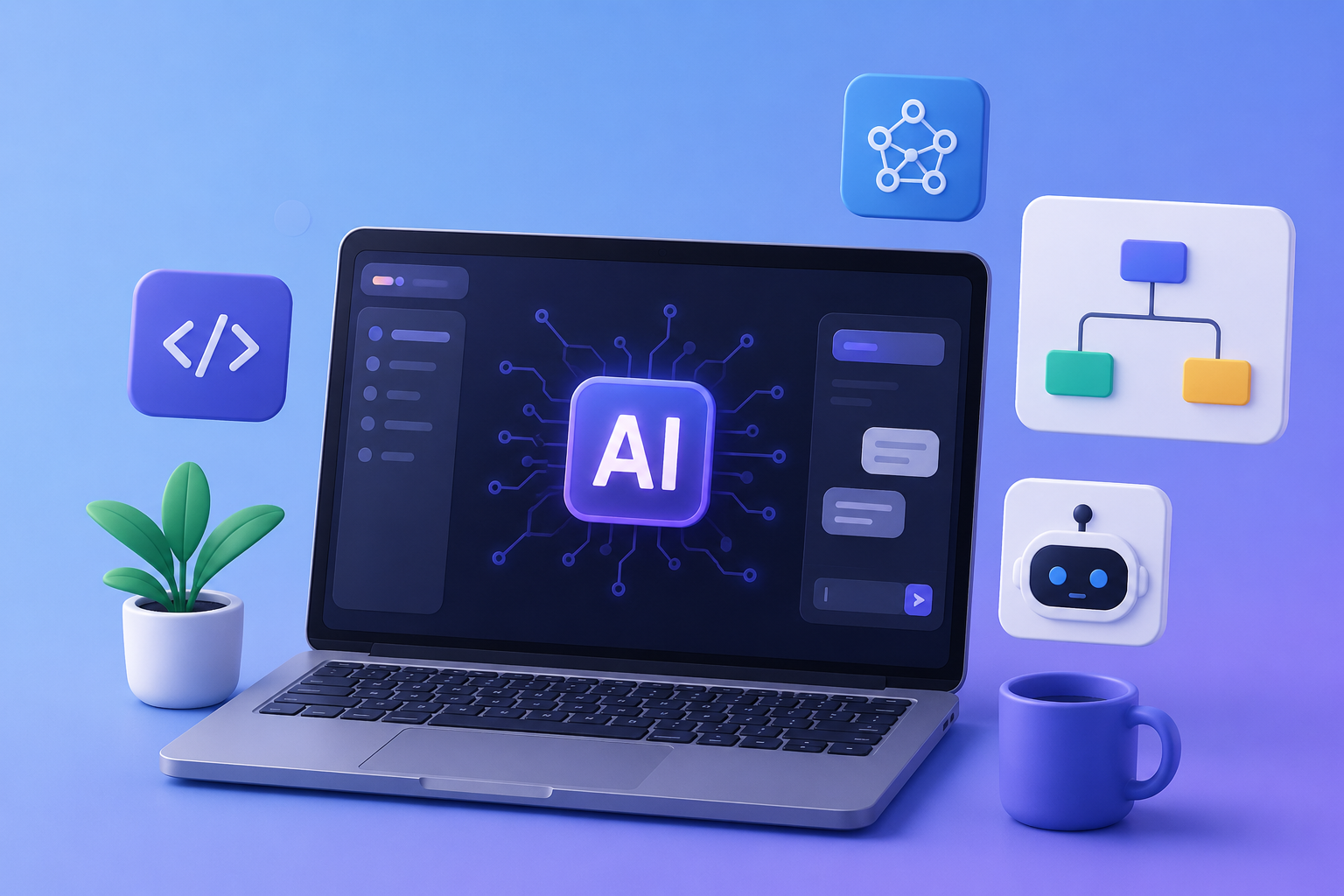
Artificial intelligence (AI) has moved from the laboratory to products faster than almost any other technology. Today, you can understand the fundamental concepts behind applications such as recommendation systems, fraud detection, and voice assistants. The barrier to entry has never been lower, and the tools available to novice developers have never been more extensive.
Yet, it can feel overwhelming at first. Where do you start? What should you build? Which tools are truly important? This guide will lead you through the fog and guide you through the entire process of creating your first AI application—from infrastructure to a functional solution for final implementation.
AI Applications: An Introduction
AI applications are software that uses data and algorithms to perform tasks that normally require human intelligence. These applications vary greatly, from simple spam filters to advanced image recognition systems. Unlike traditional software based on predefined rules, AI applications learn from data. The more data they collect, the better they perform. This forms a solid foundation for building highly useful applications.
Core Concepts of AI Explained
It is helpful to understand several core concepts before you write even a single line of code. Machine learning refers to the process of training models using data to make predictions or judgments. Deep learning is a subset of machine learning that uses multilayer neural networks to perform complex tasks, such as image and speech recognition. Natural language processing (NLP) enables programs to understand and generate human language. You do not need to be an expert in these fields to get started, but understanding their implications can help you make better decisions during the development process.
Choosing Your First AI Project
The most common mistake beginners make is choosing projects that are too ambitious. A good rule of thumb is to choose a specific, measurable problem that relates to facts you can actually obtain. Some good starting points are classifying emails as spam or not, predicting real estate values based on historical data, or identifying sentiment in product reviews. These projects are well-documented, easy for beginners to get started with, and teach fundamental skills that can be transferred to more complex applications. Get started.
Essential Tools and Technologies
AI development is primarily based on Python and features a robust ecosystem of libraries. TensorFlow and PyTorch are two of the most popular deep learning frameworks, both with extensive documentation and community support. For beginners, scikit-learn is a step-by-step introduction tool for learning traditional machine learning tasks. Jupyter Notebook offers a simple, interactive way to develop, test, and describe code. The availability of free GPU computing on platforms like Google Colab makes it unnecessary for beginners to invest heavily in expensive local hardware.
Data Collection and Preparation
Data forms the basis of all AI applications—its quality determines the maximum performance of a model. Public datasets on websites such as Kaggle, the UCI Machine Learning Library, or Hugging Face are excellent starting points for your first project. Once you have your data, preparation is crucial. This includes filling in missing values, normalizing numerical attributes, coding categorical variables, and splitting the dataset into training, validation, and test sets. Many industry professionals are familiar with data preparation. It is estimated that data preparation accounts for 60% to 80% of the total project time. By preparing your data in advance, you can prevent many problems later on.
Design Your AI Model
Once you have clean data, developing a model is relatively simple. Start with a basic model. Logistic regression or decision tree models often surprise you and provide a good benchmark. After that, you will have complex designs. Most AI frameworks work similarly: you design the structure of the model, compile the model with a loss function and optimizer, train it with your data, and then evaluate its performance on unknown data. Record your test results and the settings that yield the best results. Repetition is the engine of progress here.
Test your Application and Improve it
Overfitting is a major challenge in AI research; it refers to a model that performs well on training data but poorly on new data. Testing your application with reserved datasets provides a good picture of clear-world performance. Depending on the type of work you are undertaking, you can use metrics such as accuracy, precision, recall, and F1 score to measure model performance. Methods to improve the model, such as cross-validation, hyperparameter tuning, and regularization, can significantly improve results. The goal here is not perfection, but building a model powerful enough to process input that has never been seen before.
Implementation and Monitoring
When deploying AI applications, they must be madyou must make themers or downstream systems. Python frameworks such as Flask and FastAPI are common choices for packaging training models into APIs. Implementation and scalability are made easier with managed services offered by cloud platforms such as AWS, Google Cloud, and Azure. Tools like Streamlit allow you to build a simple web interface for a lightweight application within a few hours (without extensive front-end skills). After deployment, it is crucial to monitor how the application’s performance changes over time. As user behavior changes, data distribution changes, and model performance may decline. Methods to identify and correct these ensure the reliability of the application.
Ethical Issues in AI Development
Building AI applications carries a great responsibisignificant Biased training data can lead to biased outputs, which entails extremely high risks, especially in high-risk sectors such as recruitment, lending, or healthcare. Transparency is also crucial: consumers using AI services must understand when and how automated decisions affect them. Another important aspect is privacy, particularly regarding the processing of personal data. Legal frameworks such as the EU General Data Protection Regulation (GDPR) define standards, but ethical behavior goes far beyond simply complying with the law. Design with the end user in mind and consider potential issues before delivering the application to users.
Start Small, Think Long
Building your first AI application is both a technical challenge and a learning process. Concepts will accumulate, tools will become familiar, and what seems difficult today will become easy after a few effortless days. Choose a topic that interests you and use publicly available data. Don’t wait until you feel completely ready to start – that moment rarely comes on its own. Build something, release it, and then keep continuously improving it. It’s the best way to learn AI programming.
FAQs
1. Do I need a computer science degree to design AI applications?
No. Many successful AI specialists are self-taught. You need to master the Python programming language, have basic knowledge of statistics, and be familiar with frameworks like scikit-learn or TensorFlow to create and publish a working first project.
2. How long does it take to build your first AI application?
If you have a steady job, you can complete a basic project, such as a text classification model or a price prediction model, in one or two weeks. For more complex applications that use unique datasets or deep learning frameworks, this can take months.
3. What is the most popular programming language for AI development?
Python is the de facto standard for AI and machine learning development. With its rich library ecosystem, good readability, and strong community support, it is the most practical choice for both beginners and professionals.
4. How much training data does an AI model need?
This depends on the difficulty of the task. For simple classification problems, a few thousand labeled examples may be sufficient. Deep learning models typically require much more data, sometimes tens of thousands or more.

Cathy started out teaching herself to code through documentation and broken tutorials, which taught her more about learning than any classroom did. Now she focuses on helping others navigate the same path — figuring out why things break, how to fix them, and what trends actually matter versus what’s just noise. She has a background in cognitive science and contributes to open-source education projects.